
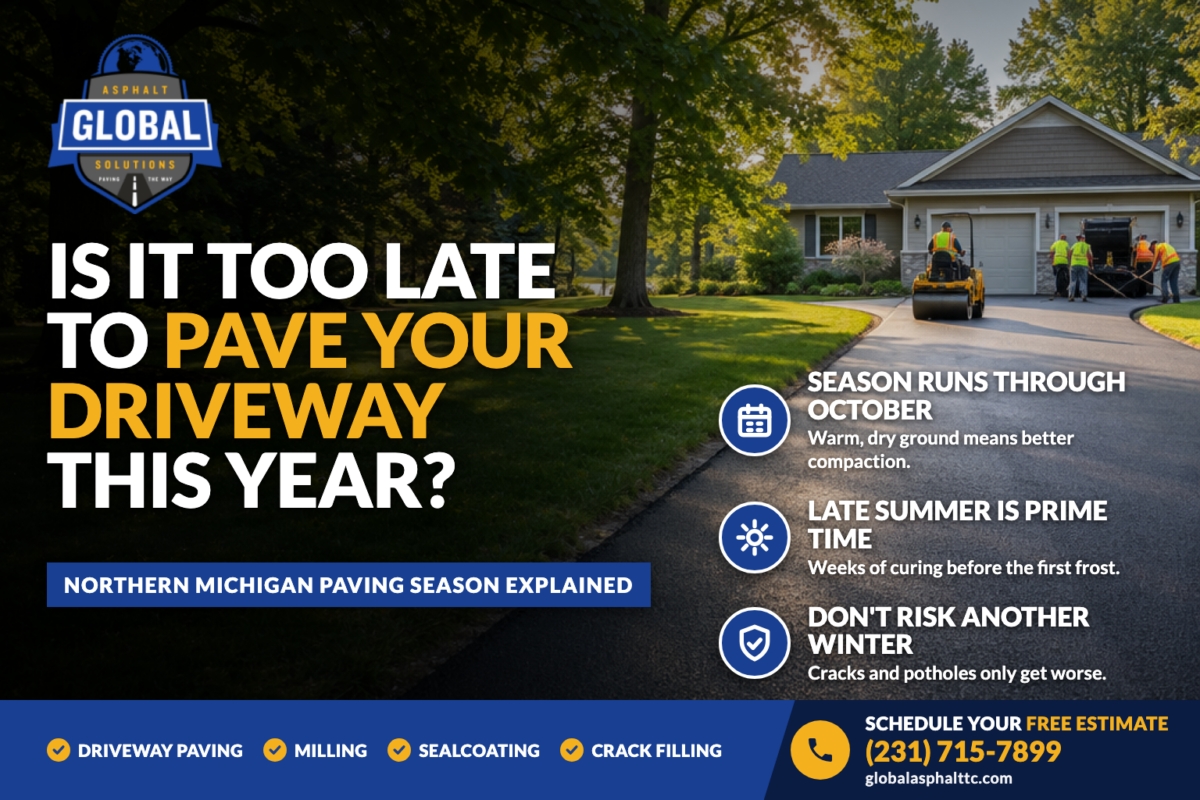
It is a question we hear every August: “Is it too late to pave my driveway this year?” The short answer is no. Late summer and early fall are some of the best weeks of the year to pave in Northern Michigan. The longer answer is that the paving season closes faster than most homeowners expect, and the calendar matters more than it does for almost any other home project.
At Global Asphalt, we pave residential driveways throughout Traverse City every season, and the homeowners who call in August almost always get a better experience than the ones who call in October. Here is why.
How Long Does Paving Season Last in Northern Michigan?
Hot mix asphalt has to be placed and compacted while it is still hot. Once the mat cools past a certain point, the rollers can no longer achieve proper density, and the driveway will not reach its full strength or lifespan.
In the Traverse City area, that means paving season typically runs from late spring through October, with a few key limits:
- Daytime air temperatures should be comfortably above 50°F
- The ground and base must be dry and unfrozen
- Asphalt plants shut down for the year once cold weather sets in, usually in November
The exact cut-off changes with the weather each year, but every week you wait in late summer is a week closer to that closing window.
Why Late Summer Is a Great Time to Pave
Spring gets most of the attention, but August and September actually offer some advantages spring cannot:
- The ground is warm and dry. Warm base material compacts better and holds heat in the new asphalt longer, which improves the final density.
- Less rain. Spring in Northern Michigan is wet. Late summer gives crews longer stretches of dry days to excavate, grade and pave without delays.
- Weeks of curing before frost. New asphalt hardens gradually over its first few months. Paving now gives the surface time to firm up before winter arrives.
- No mud season. Base preparation in a wet spring often means waiting for the site to dry. That problem mostly disappears in August.
What Happens If You Wait Until Spring
If your current driveway is already cracked, crumbling or holding water, putting the project off means it has to survive one more Northern Michigan winter.
Freeze-thaw cycles turn small cracks into large ones, water under the surface heaves the pavement, and plow blades catch every raised edge. By spring, you may be looking at:
- Potholes and broken edges that make the driveway unsafe to plow
- A soft, saturated base that has to dry out before any work can begin
- A spring schedule that fills up with everyone else who waited
Material and labor costs rarely go down over the winter either. In most cases, the driveway you pave this fall costs less than the same driveway next spring.
What a Driveway Paving Project Looks Like
Most homeowners are surprised by how quickly the work goes once it is scheduled. A typical residential project follows this order:
- A site visit and free estimate to look at drainage, base condition and access
- Removal of the old surface, or milling if only the top layer needs to go
- Grading and compacting the gravel base, correcting any low spots so water drains away from the house and garage
- Paving with hot mix asphalt at the proper thickness
- Rolling and compacting while the asphalt is still hot
Once the crew is on site, most driveways are finished in one to two days. The bigger variable is how far out the schedule is booked, which is the best argument for calling early.
Caring for a New Driveway Through Its First Winter
A driveway paved in late summer goes into winter while the asphalt is still relatively young. A few simple habits protect it:
- Keep vehicles off the surface for at least three to five days, longer in hot weather
- Avoid turning the steering wheel while the car is stationary during the first few weeks
- Keep heavy trucks, dumpsters and trailers off the driveway for the first year
- Use a board under kickstands, trailer jacks and ladders
- Ask your plow operator to keep the blade slightly raised and use a rubber or polyurethane edge
- Hold off on sealcoating until the driveway has aged 6 to 12 months, usually next summer
Read more about what sealcoating does and when to schedule it on our asphalt sealcoating page.
Not Sure If You Need a Full Replacement?
Not every driveway needs to be torn out. Depending on its condition, the right answer might be:
- Crack filling and sealcoating if the surface is faded with a few isolated cracks
- Patching or infrared repair for a handful of potholes or damaged areas
- An overlay if the base is sound but the surface is worn
- Full replacement if there are widespread alligator cracks, sinking areas, drainage problems or crumbling edges
An experienced estimator can tell the difference in a few minutes, and the honest answer is sometimes the cheaper one.
Schedule Before the Season Closes
If you have been thinking about a new driveway, August is the right time to make the call. There is still plenty of paving weather left in Northern Michigan, but the schedule fills quickly once September arrives.
Global Asphalt has paved driveways in Traverse City and the surrounding communities since 2010. We handle everything from removal and base preparation to the final roll, and we will give you a straight answer about whether your driveway needs repair, an overlay or a full replacement.
Call (231) 715-7899 or request a free estimate online, and let’s get your new driveway in before the snow flies.