
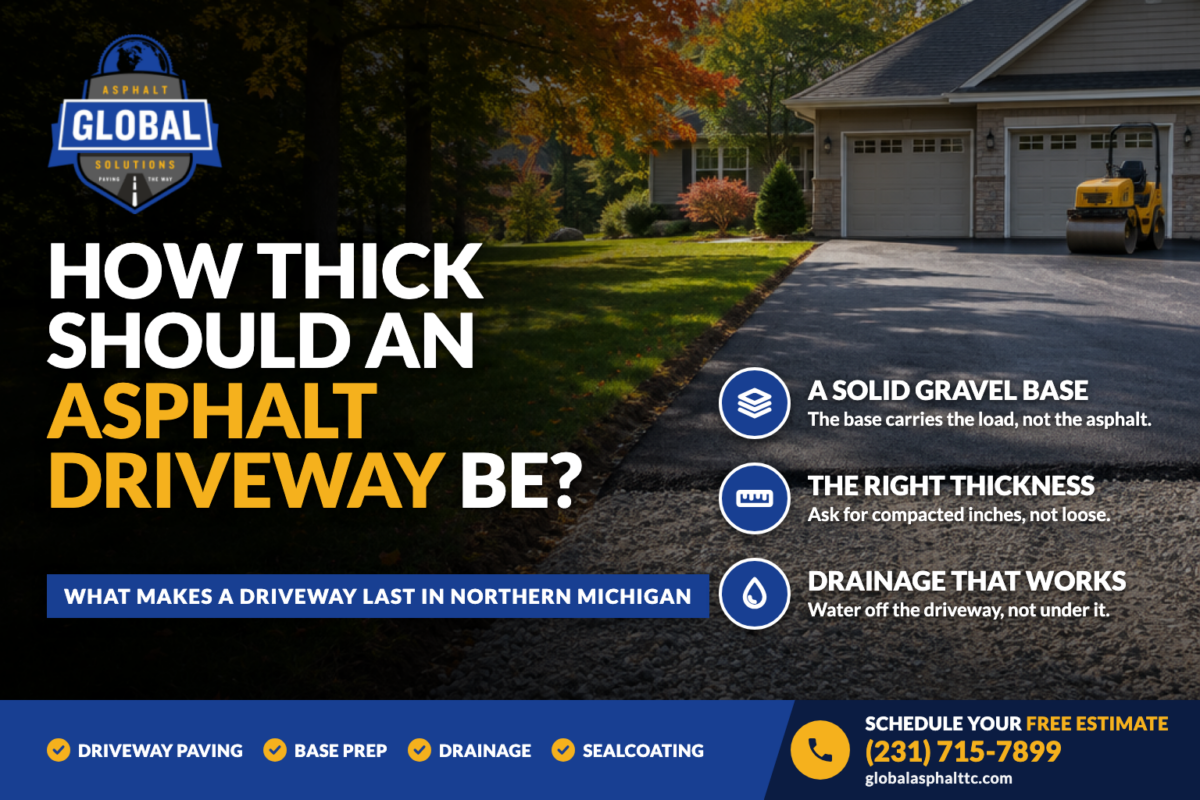
Two driveways can look identical the day they are paved and age completely differently. One is still smooth and solid after fifteen Northern Michigan winters. The other is cracking, sinking and holding water by year five. The difference is almost never the asphalt you can see. It is what is underneath it, how thick it was laid, and where the water goes.
If you are comparing quotes for a new driveway, this is the post to read first. At Global Asphalt, we have been paving residential driveways in Traverse City since 2010, and these are the details that decide how long yours will last.
It Starts Below the Surface: The Base
Asphalt is a flexible pavement. It is designed to bend slightly under load and spring back, and it relies on the gravel base underneath to carry the weight. If the base is thin, soft or poorly compacted, the asphalt above it will crack no matter how thick it is.
A well-built residential base in our area typically means:
- Removal of topsoil, old pavement and any soft or organic material
- Several inches of crushed, angular gravel, deeper where the soil is clay or holds water
- Compaction in layers with a plate compactor or roller, not just a quick pass
- A base that is graded to drain before any asphalt goes down
Alligator cracking, the web of interconnected cracks you see on older driveways, is almost always a base problem. That is why a quality contractor spends as much time on the gravel as on the paving.
How Thick Should the Asphalt Be?
For a typical residential driveway that carries cars, pickups and the occasional delivery truck, the asphalt is generally laid to a compacted thickness of about 2.5 to 3 inches. Driveways that see heavier loads, such as RVs, boat trailers, dump trucks or a home business with regular deliveries, should be built thicker, often 3 to 4 inches, and sometimes in two lifts.
Two things to know when you read a quote:
- Loose versus compacted. Hot asphalt compacts by roughly a quarter as it is rolled. A quote for “3 inches” of asphalt might mean 3 inches spread loose, which rolls out closer to 2.25 inches. Ask for the compacted thickness in writing.
- Base and asphalt are a system. Extra asphalt cannot make up for a weak base, and a strong base does not need excessive asphalt. The right combination depends on your soil and how you use the driveway.
Every property is different. Our estimator looks at the soil, the slope and how the driveway will be used before specifying the base depth and asphalt thickness for your project.
Drainage: The Detail Most Driveways Get Wrong
Water is the enemy of asphalt. It softens the base, freezes and expands in every small crack, and lifts the pavement from underneath. A driveway that holds puddles after a rain will not last, no matter how well it was built otherwise.
Good drainage design includes:
- A consistent slope away from the garage and house, usually at least a quarter inch of fall per foot
- A slight crown on wide or flat driveways so water runs to the edges
- Swales, ditches or a catch basin where the yard slopes toward the driveway
- No low spots where the driveway meets the road or the garage apron
If your current driveway has standing water, tell your contractor. Fixing the grade during replacement is far cheaper than fixing it later.
Edges and Transitions
Driveway edges take more abuse than the middle. Tires roll over them, plows catch them, and there is no support on the outside. A quality installation tapers or bevels the edges, compacts them, and backfills along the lawn with topsoil so the edge is supported rather than hanging in the air.
The transitions at the garage slab and at the road should be smooth and properly matched in height. A lip at the garage door will chip and crack within a couple of winters.
Why the Cheap Bid Is Usually Thinner
When one quote comes in far below the rest, the difference is almost always in what you cannot see: a shallower base, less compaction, or a thinner asphalt mat. The driveway looks the same on the day it is finished. The difference shows up after three or four Northern Michigan winters, when the low bid is cracking and the properly built driveway is not.
Paying for a driveway twice is far more expensive than paying for it properly once.
Questions to Ask Before You Sign
A good contractor will answer all of these without hesitation:
- What compacted thickness of asphalt will be installed?
- How deep is the gravel base, and how will it be compacted?
- How will water drain off the driveway, and where will it go?
- What equipment will be used for compaction?
- How are the edges and the transitions at the garage and road handled?
- When should the new driveway be sealcoated for the first time?
If the answers are vague, keep looking.
Get a Driveway Built to Last
There is still paving weather left this fall in Northern Michigan, and a driveway built now goes into winter with a proper base, the right thickness and drainage that works.
Global Asphalt has paved driveways in Traverse City and the surrounding communities since 2010. We will look at your site, explain exactly what we recommend and why, and put the base depth and compacted asphalt thickness in writing.
Call (231) 715-7899 or request a free estimate online to get your driveway on the schedule.